
Accelerograph: What It Is, How It Works, and Where to Get One in the Philippines
Last reviewed by USHER Technologies Inc.
An accelerograph is the instrument that records ground and structural acceleration during an earthquake. It is the core of an earthquake recording instrument (ERI), and it is the component the DPWH rules count when they say a building needs three. USHER ERI Max is a Filipino-made accelerograph.
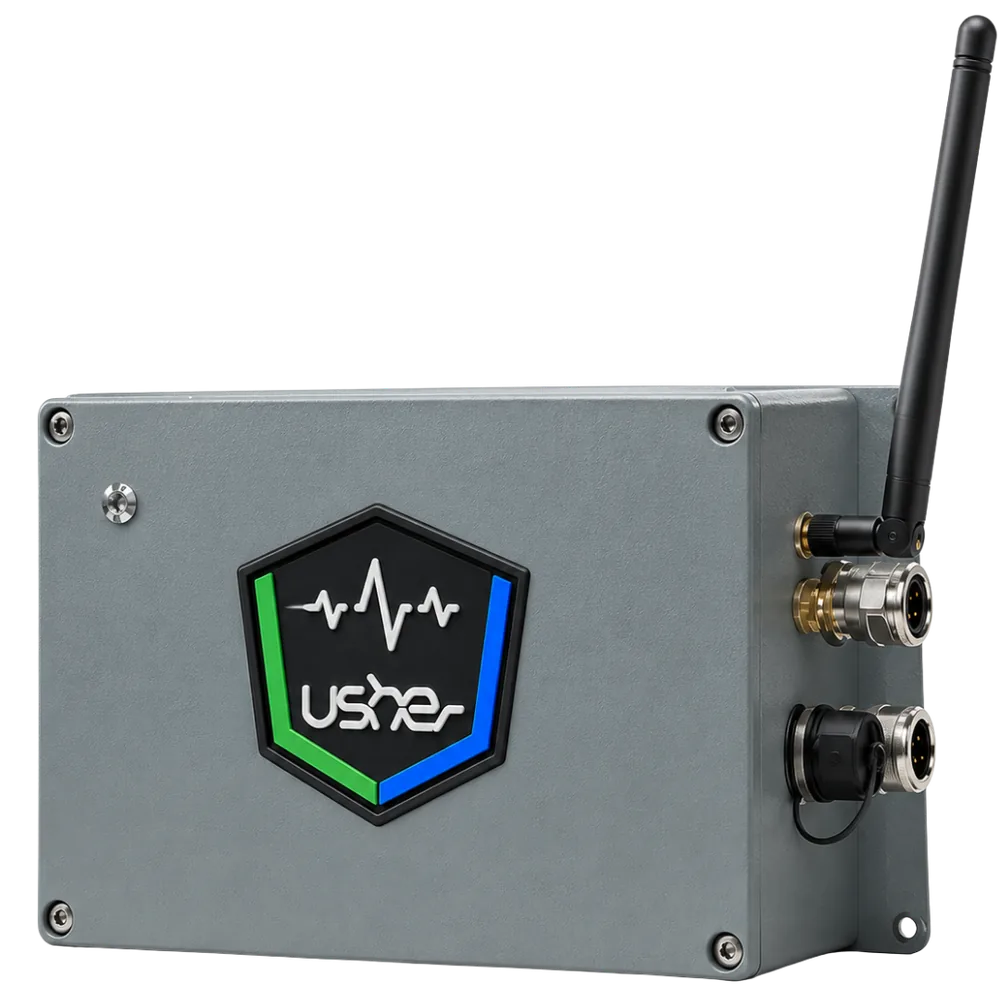
What is an accelerograph?
An accelerograph is an instrument that records acceleration as a function of time, generally in three perpendicular directions: one vertical and two horizontal. In earthquake engineering it is used to capture strong motion, meaning ground movement large enough to matter when evaluating damage to a structure.
The distinction that matters in practice is what it is built for. A seismometer is made to detect weak and distant ground motion as sensitively as possible. An accelerograph is made to stay accurate through violent shaking without saturating, because the record engineers need is the one from the earthquake that actually stressed the building.
That record is what turns an inspection from a guess into a measurement. Without it, assessing a building after a strong earthquake means reasoning backwards from visible cracking. With it, an engineer can see how much acceleration each instrumented floor absorbed and how the structure responded through the event.
How does an accelerograph work?
Three parts do three different jobs. An accelerometer senses the acceleration. The accelerograph stores that signal and processes it into intensity, velocity, and displacement. The output is an accelerogram: a time history of the shaking.
Recording is triggered rather than continuous. Under the DPWH rules the record should begin at least 20 seconds before ground shaking starts and continue for 30 seconds after the last triggering-level motion, so the instrument has to hold a rolling buffer to capture the onset it has not yet detected. Where several instruments are installed in one building they are interconnected for common start and common timing, so the floors can be compared against each other on one clock.
Accelerograph, accelerometer, accelerogram, and seismograph
These terms are often used interchangeably. The DPWH rules define each one separately, and the difference matters when reading a specification or a compliance requirement:
- Seismic accelerograph: the instrument that records ground acceleration as a function of time, generally in three perpendicular directions (one vertical and two horizontal)
- Accelerometer: the sensor that measures seismic acceleration and passes it to the accelerograph for processing and conversion to intensity, velocity, and displacement
- Accelerogram: the record an accelerograph produces, showing acceleration over time
- Seismograph: a general term for a device that detects ground motion, typically a recorder paired with a seismometer that senses ground velocity
- Strong motion: ground motion large enough to matter when evaluating earthquake damage
- Peak ground acceleration (PGA): the maximum ground acceleration at a specific location, measured in g or gals (1 g = 981.5 gals)
Where are accelerographs installed?
In buildings covered by the DPWH rules, placement follows the structure rather than convenience. A building needing three instruments takes one at the ground floor or lowest basement, one at a middle floor, and one at the floor below the roof, so the record shows how motion amplified on the way up. A building needing one takes it at the ground floor or lowest basement.
Beyond buildings, accelerographs are installed on bridges and other critical infrastructure, where the same measurement supports structural health monitoring between earthquakes as well as assessment after one.
Are accelerographs required in the Philippines?
Yes, for several building types. The requirement comes from NBCDO Memorandum Circular No. 1, series of 2015, issued by the DPWH through its National Building Code Development Office, which provides the Guidelines and Implementing Rules on Earthquake Recording Instrumentation (ERI) for Buildings. These form part of the Implementing Rules and Regulations of the National Building Code of the Philippines (Presidential Decree No. 1096) and implement Section 105.2 of the National Structural Code of the Philippines.
In short: buildings over 50 meters in Seismic Zone 4 need at least three approved recording accelerographs, and hospitals, schools, local government buildings, and large commercial and industrial buildings need at least one. NSCP 2010 allows a building official to waive the requirement, but the DPWH rules temporarily suspend that waiver until enough earthquake records have been collected, so for the covered building types it is not waivable in practice.
The full table of covered building types, the minimum requirements for the instrument itself, and the installation and maintenance obligations are set out on our earthquake recording instrument page.
Circular reference: Official Gazette, 14 July 2015 — the DPWH announcement naming NBCDO Memorandum Circular No. 1, series of 2015.
What does an accelerograph measure?
A seismic accelerograph measures acceleration — how quickly the motion of the ground or the structure changes — in three perpendicular directions at once. From that single measurement the instrument derives the other quantities engineers work with: intensity, velocity, and displacement.
The headline figure is usually peak ground acceleration, or PGA: the largest acceleration reached at that location during the event. It is expressed in g or in gals, where 1 g equals 981.5 gals. A record from an instrumented building gives a PGA per instrumented floor, which is what shows how the motion amplified between the basement and the roof.
What it does not do is predict. An accelerograph is sometimes called an earthquake detector or an earthquake monitoring device, which can suggest advance warning; it records shaking as it happens, and its value is the evidence it leaves behind.
Which buildings need an accelerograph?
Under Table 1 of the DPWH rules, what you need depends on what kind of building you own and how big it is. The thresholds below are the requirement as written; your Building Official confirms what applies to a specific structure.
Property developers and building owners
A private building over 50 meters needs at least three accelerographs: one at the ground floor or lowest basement, one at a middle floor, and one at the floor below the roof, interconnected for common start and common timing. For a newly constructed building, installation is a pre-condition for the Certificate of Occupancy.
Hospitals and healthcare facilities
A hospital with 50 or more beds needs at least one accelerograph at the ground floor or lowest basement. If the hospital is over 50 meters it falls under the taller-building rule instead, which is three.
Schools and universities
A school with 20 or more classrooms and at least three storeys needs at least one accelerograph at the ground floor or lowest basement. Over 50 meters, three.
Local government units
Provincial, city, and municipal halls and buildings need at least one accelerograph at the ground floor or lowest basement. Government buildings over 50 meters, including government hospitals and schools, need three. Monitoring compliance is also an LGU responsibility: the local Building Official and City or Municipal Engineer submit quarterly compliance reports to the DPWH.
Malls and commercial centers
A commercial building with 1,000 or more occupants, or at least 10,000 square meters of gross floor area, needs at least one accelerograph at the ground floor or lowest basement.
Hotels and resorts
A hotel or resort is a commercial building for the purposes of Table 1, so the same threshold applies: 1,000 or more occupants or at least 10,000 square meters. Above 50 meters, three accelerographs.
Industrial and manufacturing facilities
An industrial building needs at least one accelerograph where it has 1,000 or more occupants and at least 10,000 square meters of gross floor area. Note that this threshold reads "and", not "or", unlike the commercial one.
Bridges and critical infrastructure
Table 1 addresses buildings, so a bridge or similar structure is not covered by it. Accelerographs are still installed on them as part of structural health monitoring, where the same measurement supports both routine assessment and inspection after an earthquake.
Table 1 applies within 200 km of a Type A fault; beyond that, one accelerograph at the ground floor or lowest basement may suffice. These thresholds are the written rule, not advice on a particular building — confirm yours with your Building Official.
Where to get an accelerograph in the Philippines
USHER Technologies Inc. builds two, both developed and made in the Philippines:
- USHER ERI Max — a high-precision accelerograph integrated with the USHER Portal, for buildings, bridges, and critical infrastructure covered by the DPWH rules
- USHERette — a palm-sized, lower-cost mini ERI built on an accelerometer and gyroscope, for residential buildings and smaller structures
The DPWH prohibits mixing seismic equipment parts from different brands and requires the supplier to guarantee at least ten years of maintenance, so the practical question is not only which instrument but who will still be servicing it in a decade.
Frequently asked questions
What is an accelerograph?
An accelerograph is an instrument that records ground acceleration as a function of time, generally in three perpendicular directions: one vertical and two horizontal. Under the DPWH rules, it stores the seismic data gathered by its attached accelerometer. It is the core of an earthquake recording instrument.
What is the difference between an accelerograph and an accelerometer?
The accelerometer is the sensor that measures seismic acceleration. The accelerograph takes that information, stores it, and processes it into intensity, velocity, and displacement.
What is the difference between an accelerograph and a seismograph?
Seismograph is a general term for a device that detects ground motion, typically a recorder paired with a seismometer that senses ground velocity. It is usually more sensitive than an accelerograph. An accelerograph records acceleration, which suits the strong shaking engineers need to evaluate in buildings.
What is the difference between an accelerograph and a seismometer?
A seismometer is a sensitive instrument built to detect weak ground motion, including small or distant earthquakes. An accelerograph records strong shaking as acceleration, which is what engineers need to see how a building was stressed. That is why an earthquake recording instrument for buildings is built around an accelerograph.
What is an accelerogram?
An accelerogram is the record an accelerograph produces: a time history of acceleration during an earthquake. For buildings covered by the DPWH rules, recording should run from at least 20 seconds before the ground shaking begins until 30 seconds after the last triggering-level motion, so engineers can review the full event.
How many accelerographs does a building need in the Philippines?
Under the DPWH rules, a building over 50 meters in Seismic Zone 4 needs at least three approved recording accelerographs, placed at the ground floor or lowest basement, a middle floor, and the floor below the roof, interconnected for common start and common timing. Hospitals with 50 or more beds, schools with 20 or more classrooms and at least three storeys, local government buildings, and large commercial and industrial buildings need at least one, at the ground floor or lowest basement.
Is an earthquake detector the same as an accelerograph?
In Philippine practice the terms earthquake detector, earthquake monitoring device, seismic accelerograph and earthquake recording instrument are all used for the same equipment. The DPWH rules use accelerograph, and that is the term to look for when checking whether a product meets the requirement.
Where can I get an accelerograph in the Philippines?
USHER ERI Max is a Filipino-made, high-precision accelerograph integrated with a web portal, from USHER Technologies Inc. USHERette is a palm-sized, lower-cost option for smaller structures. Email inquiries@usher.ph to request a quotation or a demo.
Is an accelerograph the same as an earthquake recording instrument?
In the DPWH rules the accelerograph is the instrument that does the recording, and an earthquake recording instrument (ERI) is what the installed, compliant system is called. In practice the terms are used for the same thing, which is why the circular counts accelerographs when it specifies how many a building needs.
Can an accelerograph predict earthquakes?
No. An accelerograph records shaking as it happens. Its value is in telling you how your structure behaved, so inspection and repair decisions can be made quickly and on evidence.
Looking for an accelerograph in the Philippines?
USHER ERI Max is a high-precision accelerograph integrated with a 24/7 web portal, designed against the DPWH Guidelines and Implementing Rules on Earthquake Recording Instrumentation and the National Structural Code of the Philippines. It is developed and made in the Philippines by USHER Technologies Inc., so service, calibration, and the ten-year maintenance the DPWH requires are all local.
Quotations and demos: inquiries@usher.ph
Sources and coverage
- All Filipino team launches structural health monitoring system — PreventionWeb
- USHER – A Universal Structural Health Monitoring System — WIPO