Earthquake Recording Instrument (ERI) in the Philippines
Last reviewed by USHER Technologies Inc.
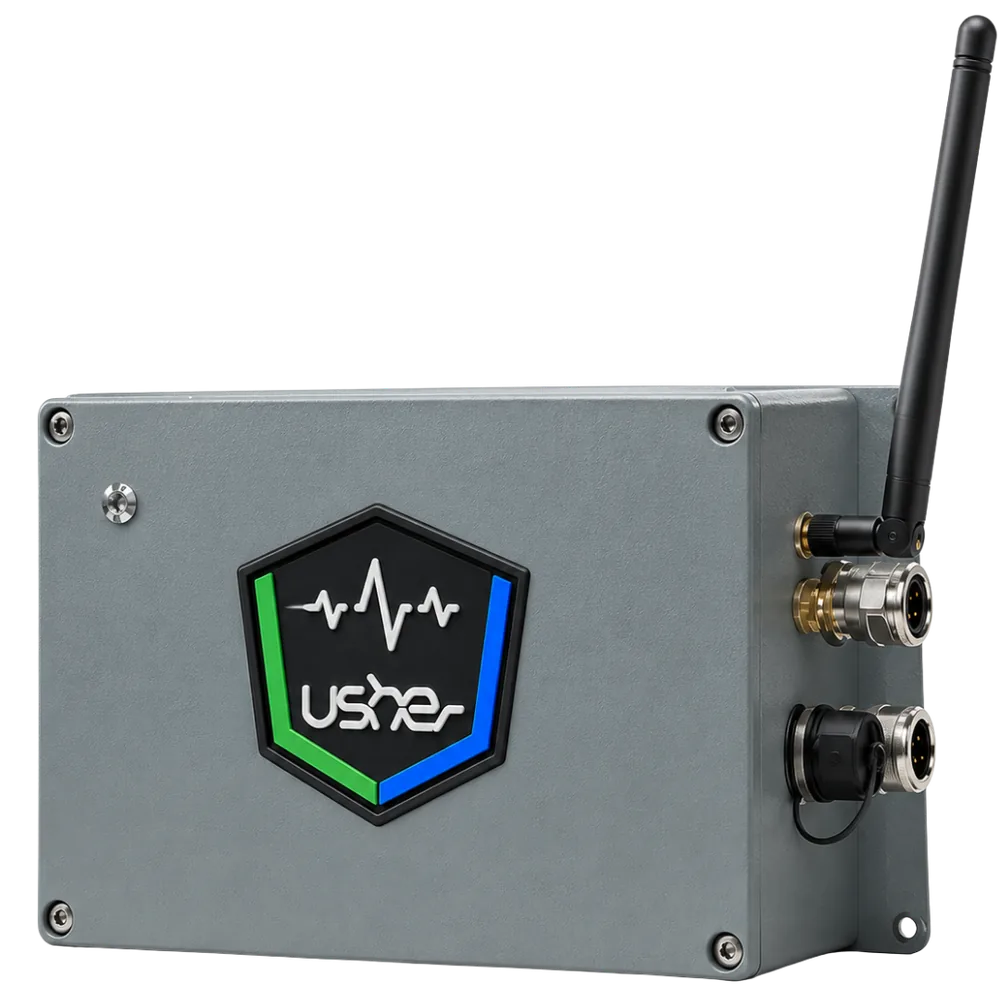
An earthquake recording instrument (ERI) is an accelerograph that records how a building shakes during an earthquake. USHER ERI Max is a Filipino-made ERI, paired with a web portal that turns that data into alerts and reports.
What is an earthquake recording instrument?
An earthquake recording instrument (ERI) is an accelerograph: a sensor that measures ground and structural acceleration and stores the record of strong shaking. Engineers use that record to understand how a structure actually responded, instead of guessing from damage alone.
In the Philippines, the rules are set by NBCDO Memorandum Circular No. 1, series of 2015, issued by the DPWH through its National Building Code Development Office (NBCDO). It provides the Guidelines and Implementing Rules on Earthquake Recording Instrumentation (ERI) for Buildings, which form part of the Implementing Rules and Regulations of the National Building Code of the Philippines (Presidential Decree No. 1096) and implement Section 105.2 of the National Structural Code of the Philippines 2010, Volume 1, 6th Edition (NSCP 2010). They set which buildings must have an ERI and what the instrument must do, and were crafted with the Association of Structural Engineers of the Philippines (ASEP) and the DPWH Bureau of Design.
NSCP 2010 states that "Unless waived by the building official, every building in Seismic Zone 4 over fifty (50) meters in height shall be provided with not less than three (3) approved recording accelerographs," interconnected for common start and common timing. The DPWH rules temporarily suspend that waiver until enough earthquake records have been collected, so for the building types in Table 1 the instrumentation is not waivable in practice.
Circular reference: Official Gazette, 14 July 2015 — the DPWH announcement naming NBCDO Memorandum Circular No. 1, series of 2015.
Which buildings need an ERI under DPWH rules?
The circular covers all existing buildings, government and private, in Seismic Zone 4 — the entire Philippines except Palawan and Tawi-Tawi, which are in Zone 2. Under Table 1 of the DPWH rules:
| Building type | Instrument location | Minimum requirement |
|---|---|---|
| Government buildings above 50 m, including hospitals and schools | Ground floor or lowest basement; middle floor; floor below roof | At least 3 accelerographs |
| Private buildings above 50 m | Ground floor or lowest basement; middle floor; floor below roof | At least 3 accelerographs |
| Hospitals with 50+ beds; schools with 20+ classrooms and at least 3 storeys | Ground floor or lowest basement | 1 accelerograph |
| Provincial, city, and municipal halls and buildings | Ground floor or lowest basement | 1 accelerograph |
| Commercial buildings with 1,000+ occupants or at least 10,000 m² gross floor area | Ground floor or lowest basement | 1 accelerograph |
| Industrial buildings with 1,000+ occupants and at least 10,000 m² gross floor area | Ground floor or lowest basement | 1 accelerograph |
Source: DPWH ERI Guidelines
Applies within 200 km of a Type A fault. Beyond that, one accelerograph at the ground floor or lowest basement may suffice. Confirm with your Building Official.
What the DPWH requires of the instrument
The DPWH specifies minimum requirements for the accelerograph itself:
- Seismic-qualified, as tested by a recognized international testing laboratory
- Fault detection and real-time alarm information (audio, visual, or both) during an earthquake
- Internal battery backup for continuous operation through power fluctuations
- Where applicable: three components (vertical, longitudinal, transverse), DC to 100 Hz bandwidth, 2g sensitivity, IP67 environmental protection, and a 10-year minimum design life
- Recording at a minimum of 100 samples per second with a 16-bit converter, GPS or NTP time, and Ethernet communication (TCP/IP, FTP/SFTP)
Installation, maintenance, and compliance
Installation is supervised by a Certified Civil/Structural Engineer and verified by the Building Official. For newly constructed buildings, installation is a pre-condition for the Certificate of Occupancy. For existing buildings, installation and operation form part of the Annual Certificate of Inspection. Monitoring of compliance sits with the local Building Official and City or Municipal Engineer, who submit quarterly compliance reports to the DPWH for the buildings in their jurisdiction.
The supplier must guarantee a maintenance period of at least 10 years, with a maximum service interval of one year and yearly calibration testing. After an earthquake of magnitude 6 or greater, the owner must retrieve the data and have it interpreted by a Certified Civil/Structural Engineer for submission to the DPWH. The DPWH also prohibits mixing seismic equipment parts from different brands, so the system should come from one supplier.
Accelerograph, accelerometer, and accelerogram explained
These related terms are often used interchangeably, but the DPWH rules define each one separately:
- Seismic accelerograph: the instrument that records ground acceleration as a function of time, generally in three perpendicular directions (one vertical and two horizontal)
- Accelerometer: the sensor that measures seismic acceleration and passes it to the accelerograph for processing and conversion to intensity, velocity, and displacement
- Accelerogram: the record an accelerograph produces, showing acceleration over time
- Seismograph: a general term for a device that detects ground motion, typically a recorder and a seismometer that senses ground velocity
- Strong motion: ground motion large enough to matter when evaluating earthquake damage
- Peak ground acceleration (PGA): the maximum ground acceleration at a specific location, measured in g or gals (1 g = 981.5 gals)
USHER ERI Max
ERI Max is USHER's flagship system: a high-precision accelerograph integrated with a web portal. It is DPWH ERI Guidelines compliant and built to the NSCP. USHER is a Filipino-made ERI, with local support.
- Real-time monitoring and analysis through the USHER Portal
- Built for buildings, bridges, and critical infrastructure
- Developed and made in the Philippines by USHER Technologies Inc.
ERI Max or USHERette?
USHERette is a palm-sized, lower-cost version built on an accelerometer and gyroscope, designed for residential buildings and smaller structures. ERI Max is the choice for buildings and infrastructure that need the full instrument.
Frequently asked questions
What is an earthquake recording instrument (ERI)?
An ERI is an accelerograph that records the acceleration of a building or ground during an earthquake, so engineers can assess how the structure responded.
Which DPWH circular requires earthquake recording instruments?
NBCDO Memorandum Circular No. 1, series of 2015, issued by the DPWH through its National Building Code Development Office. It provides the Guidelines and Implementing Rules on Earthquake Recording Instrumentation (ERI) for Buildings, as part of the Implementing Rules and Regulations of the National Building Code of the Philippines (Presidential Decree No. 1096) and the pertinent provisions of the National Structural Code of the Philippines. Some sources write it as No. 01, Series of 2015; it is the same circular.
What are the accelerograph requirements in the Philippines?
They come from NBCDO Memorandum Circular No. 1, series of 2015 — the DPWH Guidelines and Implementing Rules on Earthquake Recording Instrumentation for Buildings, which form part of the IRR of the National Building Code (PD 1096) and implement Section 105.2 of NSCP 2010. The accelerograph must be seismic-qualified, to have fault detection, real-time alarm information, and internal battery backup. Where applicable it should also have three components, DC to 100 Hz bandwidth, 2g sensitivity, IP67 protection, recording at 100 samples per second or more, and GPS or NTP timing. Buildings above 50 meters need at least three accelerographs.
Which buildings need an earthquake recording instrument?
In Seismic Zone 4 (all of the Philippines except Palawan and Tawi-Tawi), the DPWH requires them in buildings above 50 meters (at least 3 accelerographs); hospitals with 50 beds or more and schools with 20 classrooms or more and at least 3 storeys; provincial, city, and municipal halls; commercial buildings with at least 1,000 occupants or 10,000 square meters of floor area; and industrial buildings with at least 1,000 occupants and 10,000 square meters. Confirm what applies to your building with your Building Official.
Is an earthquake recording instrument required in the Philippines?
For the building types listed in the DPWH rules, yes. For newly constructed buildings, installation is part of the requirements for the Certificate of Occupancy. For existing buildings, installation and operation form part of the Annual Certificate of Inspection.
How long must an ERI supplier provide maintenance?
The DPWH rules require the supplier to guarantee a maintenance period of at least 10 years, with a maximum service interval of one year and calibration testing each year.
What must be done after a strong earthquake?
After an earthquake of magnitude 6 or greater, the Building Official requires the owner to retrieve the ERI data and have it interpreted by a Certified Civil/Structural Engineer. The data and interpretation are submitted to the DPWH.
Is there a Filipino-made earthquake recording instrument?
Yes. USHER ERI Max is a Filipino-made earthquake recording instrument and structural health monitoring system, developed by USHER Technologies Inc., a Mapúa University spin-off co-funded by DOST-PCIEERD.
What is the difference between an accelerograph and a seismometer?
A seismometer is a sensitive instrument built to detect weak ground motion, including small or distant earthquakes. An accelerograph records strong shaking as acceleration, which is what engineers need to see how a building was stressed. That is why an earthquake recording instrument for buildings is built around an accelerograph.
Can an ERI predict earthquakes?
No. An ERI records shaking as it happens. It does not predict earthquakes; its value is in telling you how your building behaved so you can decide on inspection and repairs quickly.
What is an accelerograph?
An accelerograph is an instrument that records ground acceleration as a function of time, generally in three perpendicular directions: one vertical and two horizontal. Under the DPWH rules, it stores the seismic data gathered by its attached accelerometer. It is the core of an earthquake recording instrument.
What is an accelerogram?
An accelerogram is the record an accelerograph produces: a time history of acceleration during an earthquake. For buildings covered by the DPWH rules, recording should run from at least 20 seconds before the ground shaking begins until 30 seconds after the last triggering-level motion, so engineers can review the full event.
What is the difference between an accelerograph and an accelerometer?
The accelerometer is the sensor that measures seismic acceleration. The accelerograph takes that information, stores it, and processes it into intensity, velocity, and displacement.
What is the difference between an accelerograph and a seismograph?
Seismograph is a general term for a device that detects ground motion, typically a recorder paired with a seismometer that senses ground velocity. It is usually more sensitive than an accelerograph. An accelerograph records acceleration, which suits the strong shaking engineers need to evaluate in buildings.
Where can I get an accelerograph in the Philippines?
USHER ERI Max is a Filipino-made, high-precision accelerograph integrated with a web portal, from USHER Technologies Inc. Email inquiries@usher.ph to request a quotation.
How do I request an ERI installation or demo?
Email inquiries@usher.ph to request a quotation or demo.
Sources and coverage
- Guidelines and Implementing Rules on Earthquake Recording Instrumentation for Buildings — DPWH
- All Filipino team launches structural health monitoring system — PreventionWeb
- USHER – A Universal Structural Health Monitoring System — WIPO